Every job that comes through the door starts on the bench, not with a screwdriver. Before anything gets desoldered, we want to know exactly which rail, which signal or which component is misbehaving — not "somewhere near the charging port" or "probably the board." That precision is only possible with the right test equipment, used properly. A lot of repair shops skip most of this and go straight to swapping the part that fails most often for that symptom. Sometimes that works. When it doesn't, the customer has paid for a part they didn't need and the actual fault is still sitting there.
What a multimeter actually tells you — and where it stops
A digital multimeter is the first tool on any fault, and for good reason: it's fast, it's precise, and it answers direct yes/no questions. Is this rail at 3.3V or is it at zero? Is there continuity between this pad and ground, or is that trace open? Is this fuse still a fuse, or is it now just a very small piece of wire? A good bench DMM will read down to a fraction of a millivolt — enough to tell a genuinely quiet, well-grounded rail apart from one that's leaking current somewhere it shouldn't.
But a multimeter only ever gives you one number for one instant. It can't show you that a rail which reads a perfectly normal 5V on average is actually swinging between 3V and 7V sixty times a second. It can't show you a clock line that's supposed to be toggling and isn't, or a reset pulse that's a few microseconds too short. For anything that changes over time — which is most of what actually fails on a modern board — a single steady number isn't enough information to work with.
What an oscilloscope sees that a multimeter can't
An oscilloscope doesn't give you a number, it gives you a shape: voltage plotted against time. That's the difference between knowing a rail is "at 5V" and knowing whether it's clean, whether it has ripple riding on top of it, whether it's supposed to be pulsing and isn't, or whether it browns out for a few milliseconds under load and recovers before a multimeter would ever catch it. A lot of intermittent faults — the ones that only show up when a device gets warm, or only under certain load conditions — are invisible to a DMM and obvious on a scope.
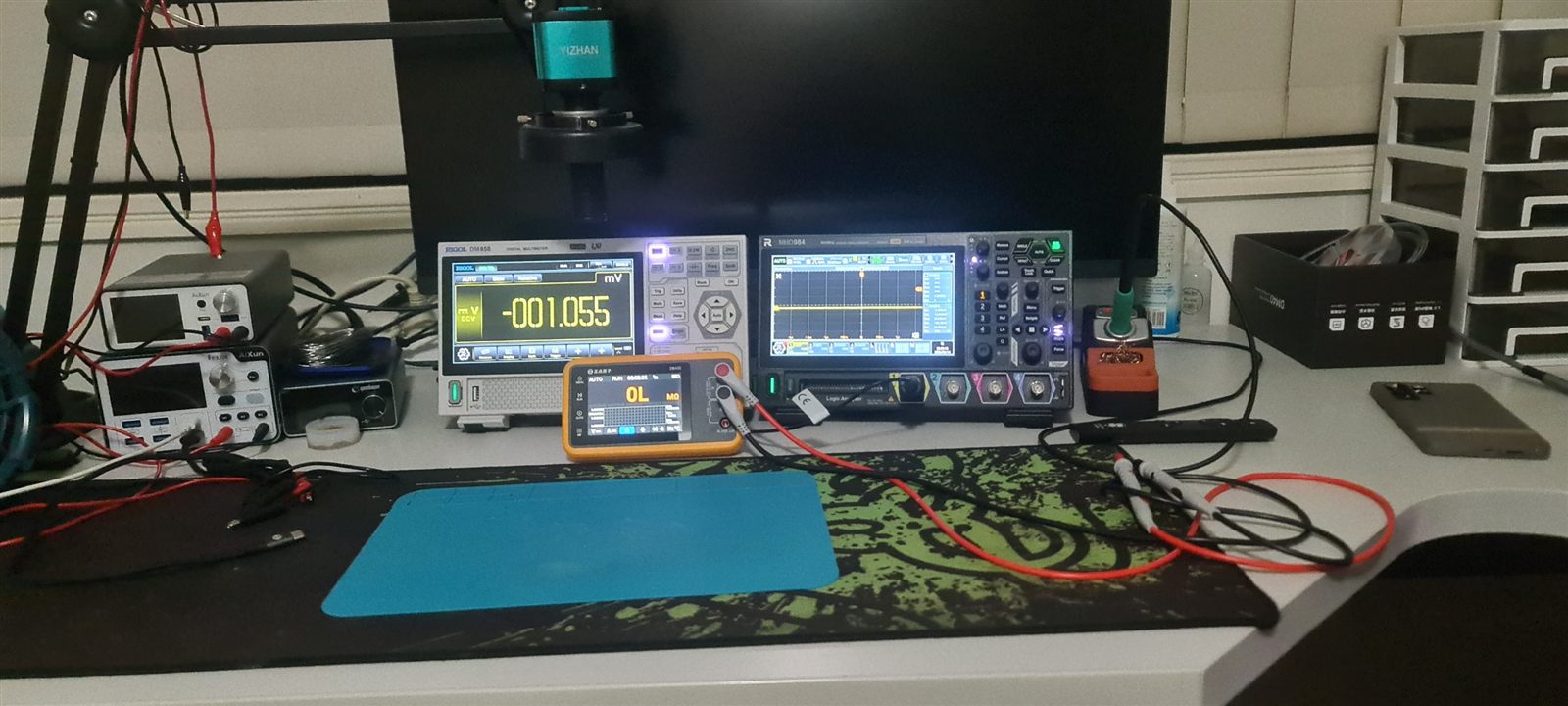
The mixed-signal scope on our bench also carries logic analyser channels alongside the analog inputs, which matters for anything with a communication bus — I²C, SPI, UART lines between a controller and a peripheral. Being able to see the analog supply rail and the digital logic states on the same timeline, at the same moment, is often the only way to tell whether a chip is failing to respond because it's not getting clean power, or because the bus itself is stuck.
The rest of the bench matters too
Test equipment isn't just the scope and the meter. Every board goes onto an adjustable bench power supply with the current limit set low before it ever sees full voltage — that way a dead short shows up as the current limit tripping instantly, not as smoke. An insulation resistance tester gets used on wiring and vehicle electrical work specifically to confirm there's no leakage path to earth before something gets re-energised — an "OL" (open-loop, effectively infinite resistance) reading is the good result there, and it's the difference between re-powering a repaired circuit with confidence and re-powering it as a guess. For board-level component work, a microscope camera is non-negotiable — the pitch on modern ICs is small enough that soldering accuracy without magnification is close to impossible.
Why this matters for you, not just for us
None of this equipment is cheap, and none of it is strictly necessary if the goal is just to swap parts until something works. But that approach costs the customer more in the long run — paid-for parts that didn't fix anything, repeat visits, and faults that come back because the actual cause was never found. Diagnosing with a scope, a calibrated meter and a controlled power supply takes longer than a guess, but it means the quote reflects the actual fault, and the repair, once done, is verified rather than assumed.
Got a fault that's hard to pin down?
CQ Electronics diagnoses at board level on calibrated equipment before quoting — phones, tablets, laptops, consoles, ECUs and vehicle electrical work, in Brisbane.
Request a quote →